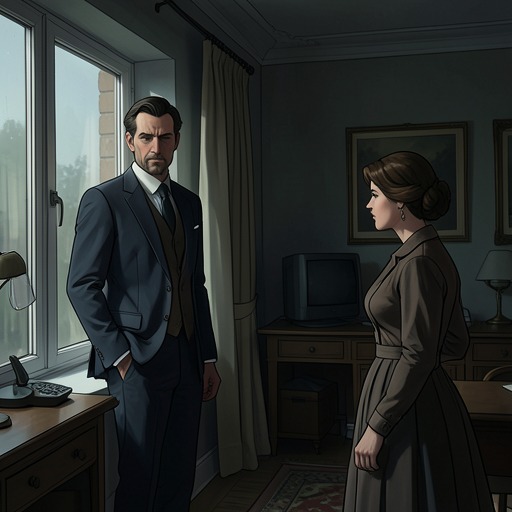
Irene’s effort to keep Brian from leaving for Brazil
Passing (Nella Larsen Edition)Irene’s effort to keep Brian from leaving for Brazil is a quiet contest over the future of their marriage and household. When Brian’s dissatisfaction resurfaces, she tries to contain it by proposing a different journey: he could take Brian Redfield Jr. to a European school the following year. The proposal is not simply a practical plan for their son; Irene hopes it will give Brian something to anticipate instead of the distant Brazil he has long wanted, and preserve the stable life she has worked to maintain.
The renewed threat
Brian first closes down the subject sharply, then turns to the immediate business of leaving. As he picks up his soft brown hat and waits, Irene thinks of how unfair it seems that, after all these years, he still blames her. She recalls that his professional success in New York City appears to confirm her earlier insistence that he remain there, and she frames her decision as having been made for him and their boys, not for herself. Yet this reasoning does not quiet her fear: his wish to go to Brazil remains alive, though unspoken, and threatens the permanence she wants for the household.
The current exchange revives an old conflict rather than introducing a new one. Irene remembers that Brian has not spoken of leaving since the earlier period of severe quarrelling, when she opposed the idea, argued that it was impossible and would have consequences for her and the boys, and even suggested that their marriage might end if he persisted. The absence of another open argument has not, in her view, meant that his dissatisfaction vanished. She believes it has continued alongside his dislike of his profession and his country, beneath the outward quiet of their life together.
Irene’s effort to manage his discontent
The possibility that she has misjudged Brian unsettles Irene, but she pushes the suspicion aside. She tells herself that she understands him exceptionally well and that this understanding has helped her make a success of a marriage that once seemed likely to fail. Her confidence is bound up with a belief that she can direct him: if his discontent has not yet died, she thinks, she can keep him moving in the right direction until it does.
That confidence coexists with a less reassuring record. Irene has previously believed that Brian’s desire to leave had faded, only to sense later that she had deceived herself and that it remained. She nevertheless insists to herself that it will eventually die. In the meantime, she believes, it must be contained and replaced by something else. Because changes unsettle her, especially changes to the household’s smooth routine, the need to devise a substitute plan feels urgent as well as irritating. She decides that something must be done immediately, even though her larger strategy depends on guiding Brian rather than openly revisiting the question of Brazil.
The proposed alternative
In the car, Irene tells Brian that she wants to discuss something requiring serious consideration. When he invites her to proceed, she begins with concern about their son. She suggests that Brian Redfield Jr. may be moving too fast at school and emphasizes that he is not yet eleven. She presents the worry cautiously, deferring to Brian’s judgment and asking whether he has noticed a problem. Brian answers that she worries about the children too much and that the boys are well, particularly their eldest.
Irene then turns to her other concern, saying that Brian Redfield Jr. may have picked up queer ideas from older boys. The opening does not produce the receptive discussion she hoped for. Her indirect approach, built around the child rather than Brian’s plans, becomes an awkward route toward the actual proposal she has in mind. The scene shows her trying to create a persuasive alternative without naming the threatened departure she wants to prevent.
Failed timing and a postponed attempt
After the exchange, Irene recognizes that she chose a clumsy opening. Her intended suggestion was that Brian Redfield Jr. attend a European school the next year and that Brian take him there. She believes Brian would have accepted the plan if she had introduced it through a more favorable opening: the journey might have offered him a break from the easy monotony that Irene cannot understand he finds hateful. The proposed trip is therefore meant to serve two purposes at once, answering a question about their son’s schooling while giving Brian a change of scene that could compete with his wish to go to Brazil.
Irene is also vexed by her own outburst of anger and wonders why she lost her temper at that moment. As her mood passes, she judges that she may have acted too hastily, raising the substitute plan too soon after Brian’s expression of discontent and thereby provoking his suspicion and obstinacy. The first attempt has failed, but she is disappointed rather than wholly discouraged. She expects another opportunity tomorrow, next week, or next month, and tells herself that Brian will not suddenly abandon everything as he might once have done. Her belief that he loves her, even if he shows it without much demonstrativeness, lets her postpone the confrontation; it does not resolve the underlying disagreement.
Significance
The episode makes Irene’s defense of domestic stability active but indirect. She does not answer Brian’s desire with a fresh argument about Brazil. Instead, she seeks to redirect his attention through their son’s education and a European journey, treating a new plan as a possible substitute for the wish she wants extinguished. Her strategy depends on the same confidence she has in her own understanding of Brian, even as the persistence of his discontent casts doubt on how fully she understands him.
The failed opening also reveals the cost of her effort to keep their established life intact. Irene’s language to Brian remains controlled, but inwardly she is agitated by the possibility that the order she has arranged may change. She wants to believe that his dissatisfaction will fade and that she can guide him until it does; the scene instead leaves the Brazil question unresolved. Her proposed alternative has not been accepted, and her plan shifts from immediate persuasion to waiting for a more opportune moment.